


Fire Rated Sealants, Uses and System Selection
Sealants are among the most visible products in passive fire protection. They are used in walls, floors, joints, penetrations and perimeter details across a wide range of projects.
But there is a common problem. Many people understand what a fire-rated sealant is supposed to do. Far fewer understand how its performance is defined.
WHAT IS A FIRE RATED SEALANT?
A fire rated sealant is a sealant used within passive fire protection to help maintain the fire resistance of a wall, floor or joint where gaps, joints or service penetrations occur.
Depending on the product type, a fire rated sealant may be used to:
- Restrict the passage of flames
- Reduce smoke leakage
- Limit the transfer of heat
- Close around penetrations in a fire
- Contribute to acoustic and air sealing performance
However, a fire rated sealant is not a standalone fire strategy. It must be part of a tested fire rated system.
Fire rated sealants and fire resistant sealants are not all the same
The market uses several overlapping terms:
- Fire rated sealant
- Fire resistant sealant
- Fntumescent sealant
- Firestop sealant
- Acoustic fire sealant
These terms are often used loosely. In technical practice, the important distinction is not the marketing label. It is the product’s tested application.
For example:
- Some fire-rated sealants are intended for narrow annular gaps around pipes and cables, like Protecta FR IPT and FR Acrylic
- Some are better suited to linear joints
- Some are designed for irregular penetrations
- Some rely on intumescent expansion to close around combustible services
- Some are valued for flexibility, movement accommodation or moisture resistance as well as fire performance
What affects the performance of fire rated sealants?
Performance depends on system conditions such as:
- Wall or floor type
- Thickness and density of the supporting construction
- Joint width or annular gap
- Seal depth
- Backing material
- Service type
- Insulation continuity
- Movement requirement
- Whether the detail is a penetration seal or a linear joint seal
This is why a fire rated sealant tested in one arrangement cannot automatically be used in another.
Industry guidance and training standards both reinforce that service penetration seal selection must account for fire performance as well as durability, acoustic requirements, air tightness and structural movement.
THE MAIN TYPES OF FIRE RATED SEALANTS
Although product chemistry varies, most fire rated sealants used in passive fire protection fall into a few broad roles.
- Acrylic fire rated sealants
Acrylic fire rated sealants are often used for:
- Linear joints
- Smaller annular gaps
- Cables and small penetrations
- Perimeter interfaces
- Wall and floor joints
Protecta FR Acrylic is positioned as a certified, flexible firestop sealant for small openings from 10–30 mm around pipes, cables and linear joints, with over 2,000 tested configurations and fire resistance up to EI 240.
That makes it relevant where the opening is relatively small, and the system design is based on a tested acrylic sealant detail.
- Intumescent fire rated sealants
Intumescent fire rated sealants, also called high-pressure expansion sealants, expand in heat. They are often used where penetrations involve materials that will soften, melt or burn away in a fire.
Typical examples include:
- Plastic pipe penetrations
- Mixed penetrations with combustible elements
- Larger service gaps where expansion is needed
Protecta FR Graphite is an advanced intumescent sealant designed to stop the spread of fire, smoke and toxic gases through service openings in fire-rated walls and floors, particularly where large plastic pipes and combustible penetrations are involved.
This is where the difference between a standard fire-resistant sealant and an intumescent sealant becomes critical.
- Highly flexible or specialist fire rated sealants
Some fire rated sealants are chosen not only for fire performance but also for their environmental or installation behaviour.
Protecta FR IPT, for example, is described as a flexible fire-rated sealant for joints, cables, conduits and pipe penetrations in walls and floors, particularly narrow openings from 10–30 mm, including humid environments and locations with movement or vibration.
That type of product matters where movement, moisture or irregular holes make a standard detail less appropriate.
FIRE RATED SEALANTS ARE ONLY ONE PART OF A FIRE RATED SYSTEM
A fire rated sealant is often one component in a wider fire stopping system that may also include:
- Fire rated boards
- Fire rated mortar
- Fire rated collars
- Fire rated wraps
- Fire rated putty
- Backings, fixings, dampers or additional sealants
For example:
- Protecta FR Board is used in larger openings and multi-service penetrations, typically together with FR Acrylic as part of a complete documented firestop system.
- Protecta EX Mortar is a fire rated mortar for service penetrations in walls and floors where a robust mortar-based seal is required.
- Protecta FR Collar is used where service penetrations through walls and floors require a collar-based intumescent response.
- Protecta FR Pipe Wrap is used around plastic pipes, conduits or metal pipes with continuous combustible insulation in walls and floors.
- Protecta fire rated putty products are used for electrical socket boxes, tap water wall boxes and other details requiring non-setting, fire and sound rated sealing.
In other words, sealants are often essential, but rarely sufficient on their own.
COMMON MISTAKES WHEN SPECIFYING FIRE RATED SEALANTS
Typical errors include:
- Selecting a fire resistant sealant without checking the test evidence
- Assuming all fire rated sealants perform equally in walls and floors
- Overlooking movement, moisture or acoustic requirements
- Using a sealant intended for narrow gaps in a larger opening
- Failing to account for combustible services
- Omitting related system components such as collars, wraps, boards or backing materials
Each of these errors can move the installed detail outside the tested system.
HOW TO CHOOSE THE RIGHT FIRE RATED SEALANT
A better selection process starts with the detail, not the product.
Ask:
- What is the supporting construction?
- Is the detail a linear joint or a service penetration?
- What services pass through the opening?
- Is there combustible pipework or combustible insulation?
- What gap size needs to be sealed?
- Is movement expected?
- Does the detail need EI performance as well as E performance?
- What full system has been tested and certified for this condition?
Those questions usually lead to a better answer than starting with a generic search for “best fire rated sealant”.
FIRE RATED SEALANTS AND COMPLIANCE
The reason this matters is simple, passive fire protection is a compliance issue.
The golden thread guidance for higher-risk buildings requires digital information that is usable, accessible and reliable as a building’s single source of truth. For fire stopping, that means system selection and installation records must be clear enough to support future inspection and management.
So when fire rated sealants are used on a project, the record should show:
- Which system was chosen
- What sealant was used
- Where it was installed
- What other system components formed part of the detail
- What evidence supports the installation
WHERE PROTECTA FITS IN
Protecta’s fire rated sealants and related fire stopping products form part of a broader evidence-based range of passive fire protection systems.
That includes:
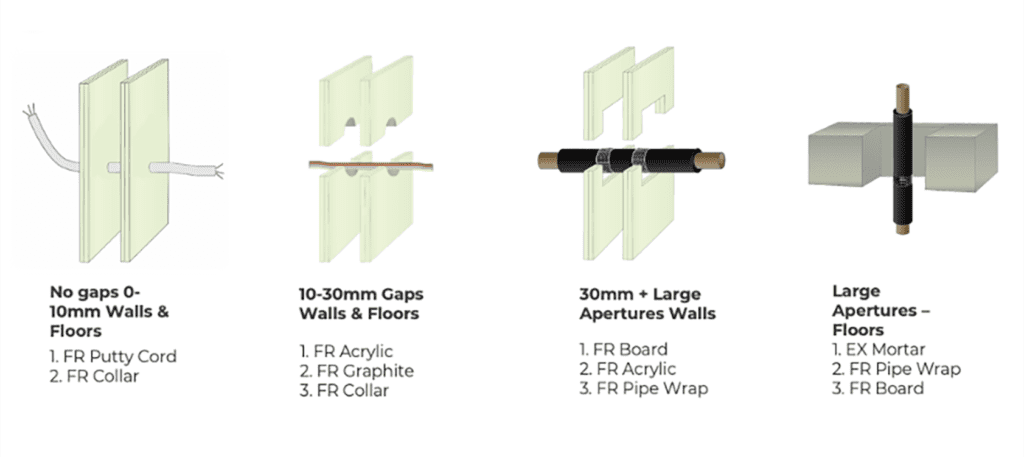
- No Gaps (0-10mm in walls and floors): FR Putty Cord and FR Collar
- No Gaps (10-30mm in walls and floors): FR Acrylic, FR IPT, FR Graphite and FR Collar
- No Gaps (30mm + large walls apertures): FR Board, FR Acrylic, FR Pipe Wrap
- Large apertures in floors: EX Mortar, FR Pipe Wrap and FR Board
Protecta also links this system thinking to digital recording through the Protecta Project Manager App, helping users connect system selection, installation and reporting.
Fire rated sealants are essential in passive fire protection and should never be treated as generic fillers. They are technical products used within technical systems.
To use them correctly, you need to understand:
- the supporting construction
- the service condition
- the tested detail
- the certification scope
- the wider fire rated system
That is the difference between sealing a gap and maintaining compartmentation.

