


WHAT DO WE MEAN BY SEPARATION DISTANCE?
In passive fire protection (PFP), separation distance is the minimum space required between services (e.g., pipes, cables, ducts) and/or between services and the edge of an aperture/fire seal. It’s not a generic rule of thumb; it’s the dimension proven in a test or technical assessment for a specific product/system, substrate and service configuration.
Why is separation distance critical?
- Stops failure by heat transfer: Too little space can concentrate heat and cause premature failure of neighbouring services or the seal itself.
- Preserves the tested system: A certified fire-stop detail is validated at particular spacings. Change the spacing and you may void the classification.
- Limits mechanical interaction: Differential expansion of metals and plastics under fire can crush, crack or pull the seal if services are packed too tightly.
- Supports smoke control and acoustics: Crowded penetrations make it harder to maintain airtightness and designed acoustic performance.
WHERE THE NUMBER COMES FROM (WHY YOU SHOULDN’T GUESS)
Separation distances are not universal. They are set by:
- Product documentation (ETA/UKTA, Technical Assessments, classification reports).
- Installation instructions from the manufacturer.
- The exact service types, sizes, insulation, substrate, and orientation tested (rigid/flexible wall, floor, composite slabs, etc.).
If your site condition differs, different pipe size, new insulation type, tighter spacing—don’t assume. Ask for a tested detail or a project-specific technical assessment.
COMMON SCENARIOS WHERE SEPARATION CAN TRIP UP A PROJECT
- Busy risers and plant rooms: Multiple services introduced late in design, forcing unplanned clustering.
- Mixed service apertures: Mixed metals, plastics, cable trays and busbars sharing an opening without a tested spacing layout.
- Edge clearance: Services run too close to the aperture edge, leaving inadequate depth for sealant/board or compromising the perimeter seal.
- Raised access floors & roof voids: Hidden spaces create “shortcuts” for fire/smoke—spacing and compartment lines must be respected.
- Retrofitting: Adding a new service next to an existing fire seal without re-checking the original classification limits.
PROTECTA PRODUCT-SPECIFIC SEPARATION DISTANCES
Distance to edge
- FR Board – 25 mm
- FR Acrylic & FR Graphite – 10 mm
- EX Mortar (floors) – 25 mm
- EX Mortar (walls) – 25 mm
- FR Collar – No spacing required, provided all four fixing lugs are secured
Distance between services for multi service openings
- Combustible services – 30mm between fire stopping where pipe wrap is required
- Non-combustible services – 0mm
Distance between apertures
- FR Acrylic – 30 mm
- FR Board – 100 mm
- FR Collar – No spacing requirement (fixing lugs must be secured)
- EX Mortar – 100 mm
- FR Graphite – 30 mm
- FR IPT – 30 mm
- FR Putty – 30 mm
- Service Transit (friction fit) – 30 mm
- Service Transit (FR Acrylic) – 30 mm
- Service Transit (EX Mortar) – 100 mm
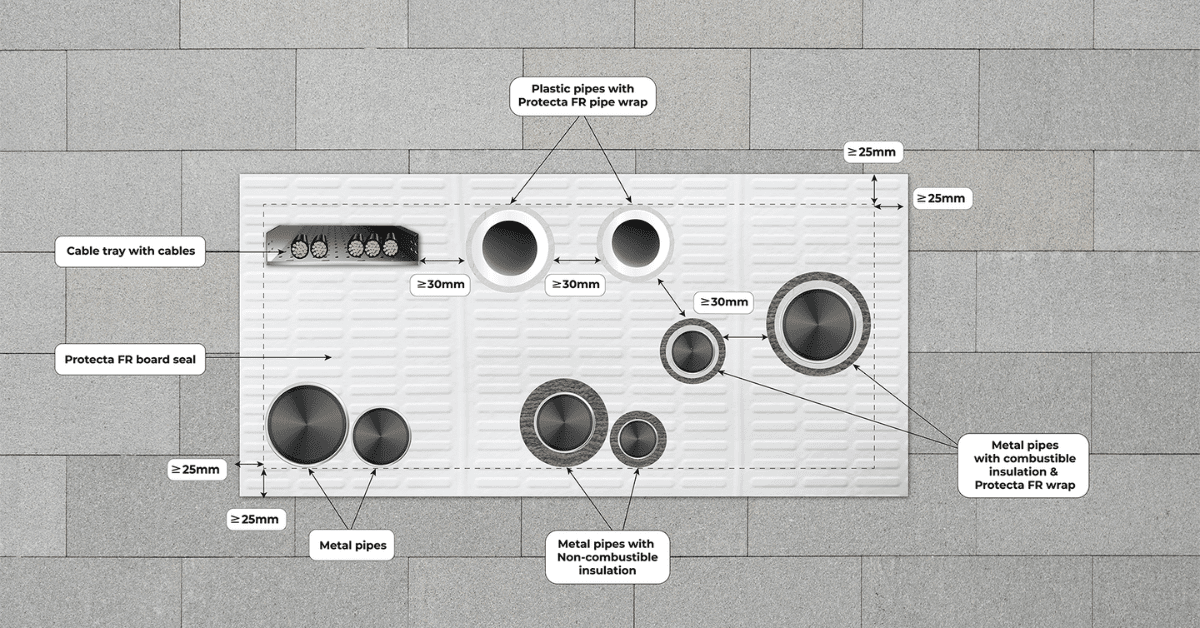
PRACTICAL DESIGN TIPS
- Lock it in early: Put separation distances on drawings, plan views and sections, not just in notes.
- Coordinate trade-by-trade: Mechanical, electrical and fire-stopping subcontractors should agree service positions and spacings before coring or framing.
- Use multi-service tested systems: Where available, choose solutions with documented layouts (e.g., pipes + cable tray combinations) to de-risk congested zones.
- Think insulation: Insulated services often need greater separations or specific products (e.g., collars/wraps/boards) to maintain EI performance.
- Uninsulated pipes – Solution may require local insulation to be installed to maintain the required Insulation (I) value. Do you have sufficient space to install local insulation on pipes if needed?
- Mind the edge: Keep required edge distances so the fire-stop material can achieve its designed depth and adhesion.
- Label and record: Photograph the installed layout with distances visible—this supports compliance and future maintenance.
When “0 mm” is acceptable—and when it isn’t
Some tested Protecta systems document 0 mm separation for particular combinations (e.g., certain metal pipes with specific insulation arrangements). That permission only applies where explicitly stated in the product’s approvals/installation instructions. If the exact combination on your site isn’t documented, treat it as not approved and contact our Technical Team.
How Protecta helps you get separation right
- Solution Finder App (mobile & web): Quickly filter for tested configurations across walls and floors, including spacing/edge requirements.
- Project packs & drawings: For complex penetrations, we provide drawing references tied to ETAs/UKTAs to keep your “Golden Thread” intact.
- Technical Assessments: If your layout isn’t in the standard literature, our engineers can assess and issue project-specific guidance.
- Training: Short, practical sessions that show how spacing, annulus, and edge distances affect EI performance.
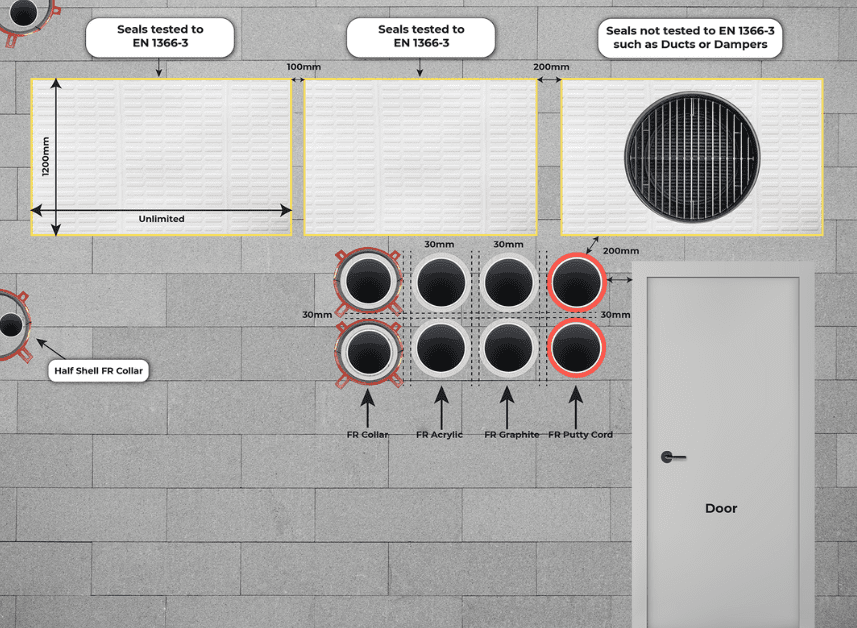
Quick on-site checklist
- Do my service types/sizes/insulation match the tested detail?
- Are service-to-service and service-to-edge distances ≥ the documented minimums?
- Is the annular space (depth/backing/sealant or board) per the drawing?
- Have I photographed and labelled the seal for handover?
NEED A SPACING DECISION YOU CAN STAND BEHIND?
Send us your plan/elevation with service sizes, insulation type/thickness, substrate, and target EI rating. We’ll point you to a tested Protecta detail or provide a technical assessment if required.
- Technical support: technical@polyseam.com
- Find tested solutions: Protecta Solution Finder
Products developed and manufactured by Polyseam Ltd.

