


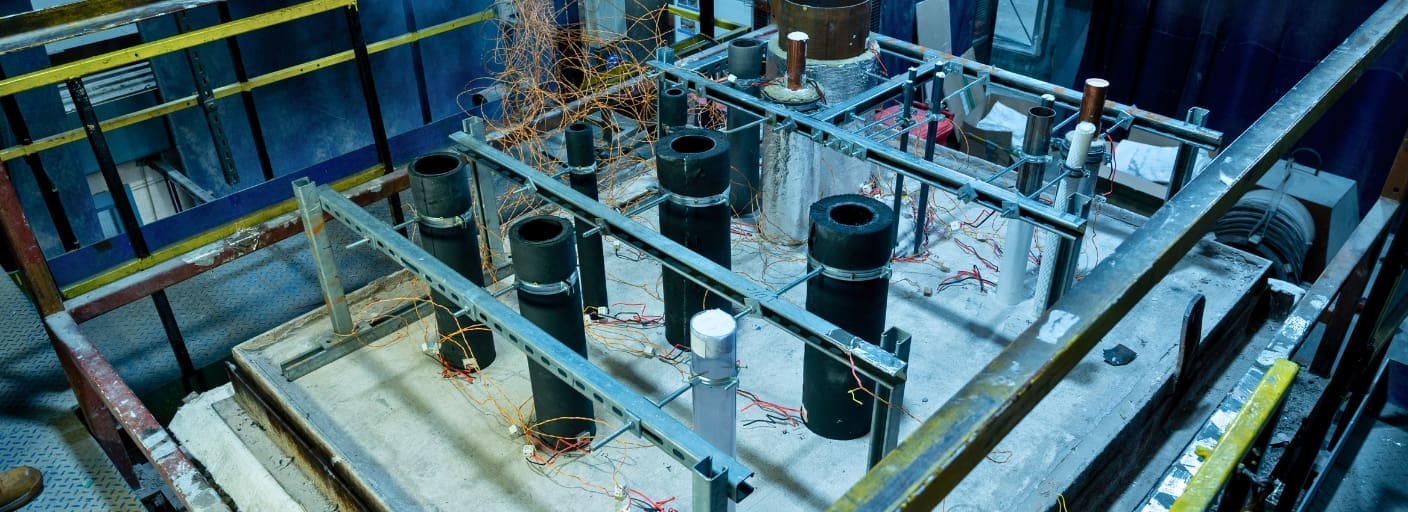
When specifying passive fire protection systems, one of the most important technical considerations is the fire resistance classification of the installation. Terms such as EI 30, EI 60 or EI 120 are widely used across the construction industry, yet the meaning behind Integrity (E) and Insulation (I) is often misunderstood. Understanding the difference between these classifications is critical when selecting, installing and documenting fire stopping systems, as they directly influence how effectively a compartment wall or floor can resist the spread of fire, smoke and heat. In this blog, we explain what EI ratings mean, how they are tested, and why both integrity and insulation play such an important role in building safety and compliance.
What EI ratings mean, why they matter, and how they are used in fire stopping design and installation
Fire stopping is often discussed in terms of products.
- Fire-rated sealant.
- Fire-rated board.
- Fire-rated mortar.
- Fire collars.
- Pipe wraps.
But the performance of a fire-stopping installation is not defined by the product alone. It is defined by the tested system and its fire resistance classification. One of the most important classifications to understand is the EI rating. EI ratings are used to describe how long a fire-stopping system can maintain two critical forms of fire resistance:
E – Integrity
I – Insulation
Understanding the difference between these two criteria is essential when selecting, specifying and installing passive fire protection systems.
WHAT IS AN EI RATING IN FIRE STOPPING?
An EI rating is a fire resistance classification used to show how long a building element or fire stopping system can maintain both integrity and insulation during a fire test. The rating is expressed in minutes.
For example:
EI 30 = 30 minutes integrity and insulation
EI 60 = 60 minutes integrity and insulation
EI 90 = 90 minutes integrity and insulation
EI 120 = 120 minutes integrity and insulation
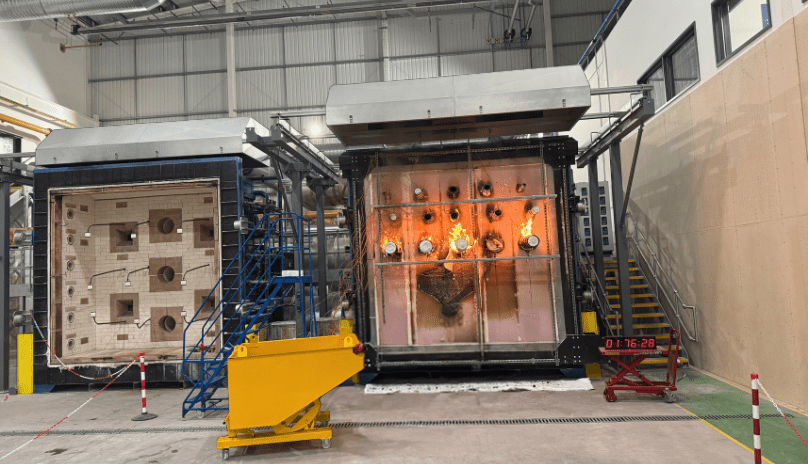
In fire stopping, EI ratings are used for systems such as penetration seals, linear joint seals and other compartmentation details. Penetration seals are commonly tested to EN 1366-3, which assesses whether a seal can maintain the fire resistance of a separating element where services pass through it. The test considers the integrity and insulation performance of the seal, the services and the surrounding construction.
WHAT DOES E MEAN IN FIRE RESISTANCE?
E stands for Integrity.
Integrity measures the ability of the fire-stopping system to resist the passage of:
- Flames
- Hot gases
- Smoke paths created by fire exposure
If integrity fails, fire can pass through the compartment line and spread to the unexposed side. In practical terms, integrity is about keeping the fire contained. For fire-stopping systems, this means the installed detail must remain closed and stable enough to prevent fire and hot gases from passing through the opening for the stated period.
An E 60 classification means the system maintained integrity for 60 minutes during the relevant fire resistance test.
WHAT DOES I MEAN IN FIRE RESISTANCE?
I stands for Insulation.
Insulation measures the ability of the system to limit temperature rise on the unexposed side of the wall or floor. This matters because a system may stop flames from passing through but still allow dangerous heat transfer.
If the unexposed side becomes too hot, it can create risk to:
- People escaping or working nearby
- Combustible materials close to the wall or floor
- Adjacent rooms or compartments
- Sensitive building services
Approved Document B explains that fire resistance performance is indicated by classifications including load-bearing capacity, integrity and insulation for a period of minutes, and that “I” refers to resistance to fire in terms of insulation.
E VS EI: WHAT IS THE DIFFERENCE?
The difference is simple but important. A system classified as E has demonstrated integrity only. It has resisted the passage of flames and hot gases for the stated time. A system classified as EI has demonstrated both:
- Integrity
- Insulation
This means it has resisted fire spread and limited temperature rise on the unexposed side. A system may achieve E 120 but only EI 60, depending on the tested configuration. That distinction matters in design. If the project requires EI 120, an E 120 detail is not equivalent.
WHY INSULATION PERFORMANCE IS OFTEN MISUNDERSTOOD
Insulation is sometimes overlooked because it is less visible than integrity. If there is no flame passing through the wall or floor, the installation may appear to be performing. But fire resistance is not only about visible flame; heat transfer can be just as important.
For example, metal pipes can conduct heat through a compartment line. Some services may require local insulation to maintain the required insulation performance. Other systems may need a specific depth of seal, backing material or product combination to achieve the declared EI rating. This is why the tested system must be followed exactly.
HOW EI RATINGS ARE USED IN FIRE STOPPING PLANNING
EI requirements should be considered before installation begins. They are normally defined by the fire strategy, building design, compartmentation requirements or project specification. Once the required fire resistance period is known, the correct tested fire-stopping system must be selected. This means checking:
- The wall or floor construction
- The fire resistance requirement
- The service type and size
- Whether the service is insulated
- The aperture dimensions
- The annular space
- Separation distances
- Product combination
- Installation method
A fire-stopping system should meet or exceed the required classification for the specific application.
HOW EI RATINGS APPLY TO SERVICE PENETRATIONS
Service penetrations are one of the most common fire-stopping challenges. Every service behaves differently in a fire.
- Plastic pipes can soften and collapse.
- Metal pipes can conduct heat.
- Cable trays can affect seal design.
- Insulated pipes may require specific detailing.
- Mixed services increase complexity.
For this reason, fire-stopping systems for service penetrations must be selected based on the exact tested detail. EN 1366-3 is used to assess penetration seals where services pass through fire-resistant walls and floors. The test is intended to evaluate whether the penetration sealing system maintains the fire resistance of the separating element.
WHY THE SUPPORTING CONSTRUCTION MATTERS
The wall or floor is part of the system. A fire-stopping detail tested in one construction cannot automatically be used in another. A system tested in a rigid concrete wall may not apply to a flexible gypsum partition.
A system tested in a concrete floor may not apply to a CLT floor or lightweight construction. The EI rating is only valid within the tested or approved scope. That is why technical data sheets, classifications and installation instructions must be checked before work begins.
WHY SERVICE INSULATION CHANGES THE RESULT
Insulation is one of the most important variables in fire stopping.
A service may be:
- Uninsulated
- Continuously insulated
- Locally insulated
- Insulated with combustible insulation
- Insulated with non-combustible insulation
Each of these conditions can affect the fire-stopping system.
For example, uninsulated metal pipes can transfer heat quickly through the wall or floor. In some tested systems, additional insulation may be required to achieve the required EI performance. This is why installers should not assume that a pipe detail is acceptable simply because the penetration has been sealed. The service condition must match the tested system.
COMMON MISTAKES WHEN USING EI RATINGS
Assuming E and EI are the same: They are not. Integrity only does not necessarily provide insulation performance.
Selecting a product instead of a tested system: A fire-rated product must be used in the correct configuration.
Ignoring the service type: A plastic pipe and a metal pipe may require completely different systems.
Changing the substrate: The tested construction must match the site conditions.
Forgetting insulation requirements: Insulation can be critical to achieving EI performance.
Poor documentation: If the tested detail cannot be identified later, proving compliance becomes difficult.
PROTECTA PRODUCTS AND EI-RATED SYSTEMS
Protecta systems are developed and tested to support a wide range of passive fire protection applications. Depending on the tested detail, this may include:
- Protecta FR Acrylic for linear joints and service penetrations
- Protecta FR Board for larger openings and multi-service penetrations
- Protecta FR Pipe Wrap for combustible pipe penetrations
- Protecta FR Collars for plastic pipes
- Protecta EX Mortar for robust wall and floor openings
- Protecta FR Coating as part of tested board and barrier systems
- Protecta FR Putty Cord for flexible sealing applications
The important point is that each product must be used as part of the correct tested system.
EI RATINGS AND DOCUMENTATION
A compliant fire-stopping installation should be recorded clearly. Good documentation should show:
- Location of the installation
- System used
- EI rating achieved
- Products installed
- Service type and size
- Supporting construction
- Installation photographs
- Relevant technical data or test evidence
This supports inspection, handover, maintenance and future building changes. Digital tools such as the Protecta Project Manager Software help users record installations against floor plans, attach photographs, link details to tested systems and create structured reports. This is increasingly important as building safety information becomes more traceable and accountable.
The classification comes from the system and not from the product name alone.
HOW TO SELECT THE CORRECT EI-RATED FIRE STOPPING SYSTEM
Before selecting a system, ask:
- What fire resistance period is required?
- Is integrity only required, or integrity and insulation?
- What is the supporting construction?
- What services pass through the wall or floor?
- Are services insulated?
- What is the aperture size?
- What separation distances apply?
- Does the tested system match the site condition?
- What documentation is required for handover?
If any of these are unclear, the installation should be checked before work begins.
WHY TECHNICAL SUPPORT MATTERS
Fire stopping is not always straightforward because real site conditions often differ from drawings.
- Openings change.
- Services are added.
- Space becomes restricted.
- Substrates vary.
When this happens, the required EI rating does not change. But the system needed to achieve it might. Protecta’s technical support team can help identify tested systems, review project details and support customers in selecting the correct solution for the fire resistance requirement.
EI RATINGS PROTECT MORE THAN COMPLIANCE
EI ratings are not just technical labels. They help define whether a fire-stopping system can maintain compartmentation, limit fire spread and control heat transfer for a defined period. Integrity keeps fire and hot gases from passing through, and insulation helps limit dangerous heat transfer; both are important. When planning fire stopping, the correct EI rating must be understood, specified, installed and recorded.
That is how fire stopping gets done right the first time.
Products developed and manufactured by Polyseam Ltd.

